

In 2001, two of my aunts, one on each side of the family, were diagnosed with breast cancer. In May of that year, I ran in honor of them in my first 5k, The Race for the Cure – Washington D.C.
Photo by Maksim Larin on Unsplash
A year later, I met the founder of The Susan G Komen foundation and Susan’s sister, Nancy Goodman Brinker, when I competed in another Race for the Cure. This time it was a sprint triathlon in Orlando, Fl.
I had made pretty good time in the swim, decent time in the 10 mile bike, but then hit the bike-to-run transition wall. My legs went on strike and refused to cooperate, and all I could do was walk. Slowly. So as I entered the Magic Kindom for the last section of the race, I found myself with a group of other walkers.
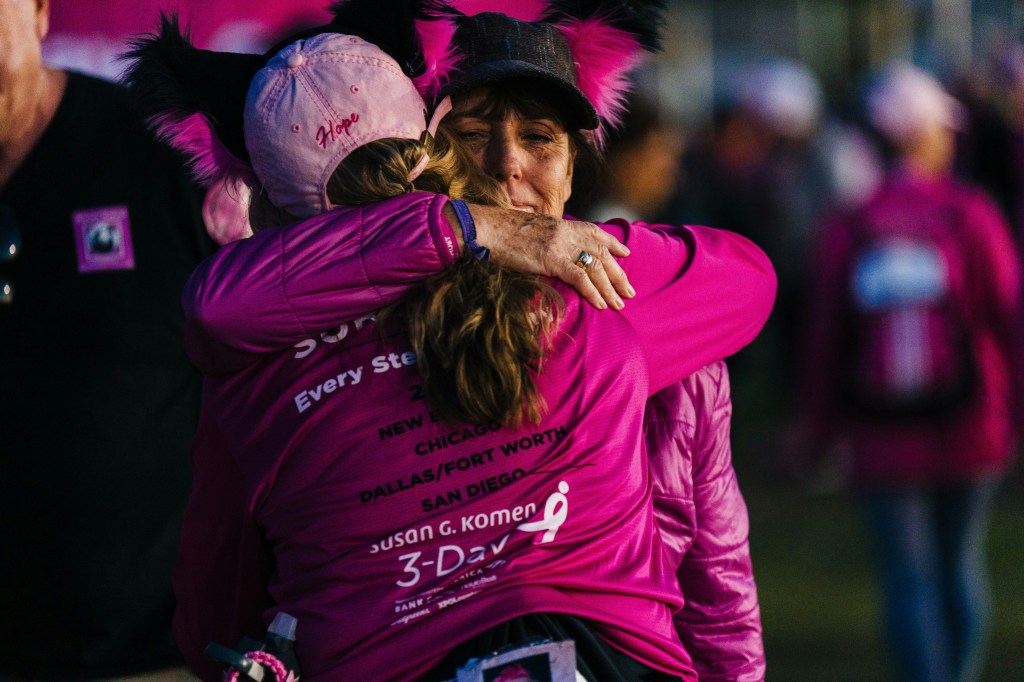
Photo by Susan G. Komen 3-Day on Unsplash
At the time, Brinker had a rule that she would participate in every race and would always be the last runner in those races so that no one else would ever be last. She was in that group I’d joined and there was a part of me was almost thankful for the slowdown so that I could witness first hand her promise to always bring up the rear. It told me so much about her as a person, and as the founder of the organiztion that enabled her to keep her promise to spread breast cancer awareness in memory of her sister.
But awarness isn’t everything. Nearly everyone has or will know someone with breast cancer, and everyone has their own story — as survivor, caretaker, loved one, friend. The races were (and still are) great calls to action and effective fundraisers, but at the time they were primarily targeted to athletes who could complete 5k runs, 3-day walks, and sprint triathlons.
As successful as the foundation has been in raising funds, over the years it has experienced some growing pains and taken some misteps. Some notable ones include:
- Instances of “pink-washing” in which “a company or organization that claims to care about breast cancer by promoting a pink ribbon product, but at the same time produces, manufactures and/or sells products containing chemicals that are linked to the diseases” (PINKWASHING – Queer Cultures 101, 2023).
- Dedicating funds to awareness and overhead rather research (Q, 2017)
- And controversial social media marketing campaigns (L Mahoney & Tang Tang, 2017)
Cyberactivism
With the advent of social media, the Susan G. Komen Foundation, like other organizations, experiemented with increasing their reach through the fairly new social networking site, Facebook. They created memes encouraging women to update their status with: 1) “the colors of their bra and their first names; 2) the location where they like to put their purse, and 3) put the number, followed by the word “inches,” and how long it takes to do (their) hair.” (L Mahoney & Tang Tang, 2017)
The memes went viral. But why?
First, people like to feel like they are doing some good in the world. Cyberactivism, where people use the internet to promote a cause or charity, lets them share with their communities which ones are important to them. These memes then directed them to personalize the message even more by providing information that was individual to them — THEIR bra color, THEIR purse location.

Photo by Sincerely Media on Unsplash
Second, getting involved was easy to do. Just a quick one or two word status update. And the messages were funny, even though it was for a serious cause. (Though many people took exception to the sexualization of breast cancer) (Baralt, n.d.)
And finally, I think these campaigns were successful in getting women to participate because of the sense of community that was involved. Men did not receive these “call to action” memes in their private messages. This was content that women, as a collective, could relate to and they enjoyed being in on the secret together.
If all the foundation wanted out these campaigns was awareness, then they probably met their goal (although the exclusion of men in their outreach may have negatively affected their brand awareness). If mobilization was what they were hoping to achieve, then they fell flat. True cyberactivism has to lead to “real-life mobilization efforts.” Increases in the number of donations, volunteers, and race participants would have been tangible outcomes of a successful social media marketing campaign, and there is little evidence any of that happened. (L. Mahoney & Tang Tang, 2017)
More than Pink
A review of the foundation’s social media pages and website reveals that their social media learning curve has significantly flattened since their first campaign in 2010. Their Instagram and X(Twitter) feeds feature patient and survivor stories, educational links, brand partnerships that make sense, and updates on advocacy. They also have calls to action such as birthday fundraising on social networking sites as well as fundraising through school clubs and sports teams. And it seems like they have made a move to rebrand themselves past the just the pink ribbon, and have created a new racing event, the More than Pink Walks. (Race for the Cure, n.d.)
Sources Cited
Baralt, L. (n.d.). Please Stop Staring at my Breasts! The Sexualization of Breast Cancer. Retrieved August 20, 2024, from https://www.bcaction.org/site-content/uploads/2014/12/Sexualization-of-Breast-Cancer-slides.pdf
PINKWASHING – Queer Cultures 101. (2023, October 21). Emory.edu. https://scholarblogs.emory.edu/queercultures101/2023/10/21/pinkwashing/#:~:text=Breast%20Cancer%20Prevention%20Movement
Q. (2017, October 19). The problems with Susan G. Komen. The Appalachian. https://theappalachianonline.com/problems-susan-g-komen/
Race For The Cure. (n.d.). Susan G. Komen®. https://www.komen.org/how-to-help/attend-events/race-for-the-cure/
 THE CRAFTY QUILLER